
Authorization is not a date. It's an evidence stream that has to keep flowing.
FISMA, FedRAMP, CMMC L2, and StateRAMP all expect continuous monitoring. The asset-discovery layer of that evidence stream is where many programs lose ground between authorizations — the inventory is current on assessment day and stale by quarter-end. CybrIQ produces inventory evidence continuously, with the audit-trail format the assessor expects.
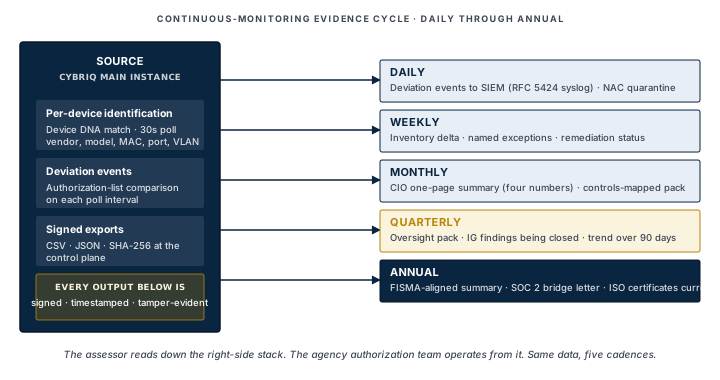
What "continuous" means in continuous monitoring
NIST SP 800-137 defines Information Security Continuous Monitoring (ISCM) as ongoing awareness of information security, vulnerabilities, and threats to support organizational risk-management decisions. In practice, that translates to recurring evidence on a regular cadence — typically monthly or quarterly — that the controls in the SSP are still in force.
For device-discovery controls (CM-8, CM-8(1), CM-8(2), CM-8(3), SI-4), continuous monitoring means: the inventory reflects what's currently on the network, deviations are detected automatically, and the agency can show an auditor the inventory's state on any past date. Many programs handle this with a manual quarterly CMDB reconciliation. That works on assessment day; it does not work between assessments.
What CybrIQ supplies for the evidence stream
- Per-device record, timestamped. Identifier, MAC, switch port, VLAN, vendor identification, model class, last-seen timestamp, confidence score.
- Deviation log. Every device that appears on the network and is not on the authorized-hardware list, with the time of first detection and the agency response.
- Inventory snapshots on demand. Reconstruct the inventory's state on any past date within the retention window.
- Audit-trail export. CSV, JSON, and PDF outputs structured for SSP attachments, eMASS uploads, and POA&M reference.
- Signed exports. Output is signed at the control plane with a SHA-256 hash; the assessor can verify the file has not been edited between export and assessment.
Controls and frameworks CybrIQ supports compliance with
- NIST SP 800-137 — ISCM strategy implementation for the device-discovery feed.
- NIST SP 800-53 Rev. 5 — CA-7 (Continuous Monitoring), CM-8 family, SI-4 (System Monitoring).
- FedRAMP Continuous Monitoring strategy — Monthly POA&M and recurring assessment artifacts.
- CMMC 2.0 Level 2 — CM.L2-3.4.1 evidence layer for the C3PAO walkthrough.
- OMB M-19-03 / M-22-09 — Continuous-monitoring data quality and zero-trust evidence.
Walk a continuous-monitoring briefing
30 minutes: we walk the ISCM evidence flow against your authorization shape and the assessor's expected artifacts.
Request briefing