
What this output looks like in front of a CIO, an oversight committee, or an Inspector General.
Most cybersecurity tools produce technical output and assume the security team will translate it for the executive audience. The translation is where the message gets thin. This page walks the reporting shape an agency CIO, an oversight committee, or an IG actually reads — the metrics that survive a non-technical audience, the audit trail that survives an oversight finding, and the formats CybrIQ ships directly.
The reporting audiences and what each one actually reads
Reporting that lands depends on who is in the room. The shape is different for each audience.
Agency CIO / CISO
Wants four numbers, monthly: how many devices are on the network, how many of those are authorized, how many deviations were detected and resolved, and what the trend is over the last quarter. Anything beyond those four is reference material that the CIO does not read in the meeting but that the CIO's staff will be expected to defend.
Oversight committee (House, Senate, agency IG)
Reads against named findings — the IG report from last cycle, the GAO recommendation that the agency accepted, the testimony commitment from the agency head. The reporting shape needs to map back to the specific finding and show "what was the gap, what did the agency do, what does the evidence show now."
Inspector General audit team
Reads against testability. The audit team wants to be able to ask "show me the device count on this date, on this VLAN, at this time" and receive a signed, timestamped record. The standard for an IG-defensible answer is the audit trail, not the summary dashboard.
FISMA reporting (OMB, CIO Council)
Annual cycle, structured against the OMB-issued FISMA metrics. The relevant metrics for device visibility are in the asset management section; CybrIQ output is structured to populate the responses directly.
The four numbers that survive a CIO meeting
- Total devices on the network. Identified count vs. the asset register count. A gap between the two is the conversation.
- Authorized vs. unauthorized. Of the identified devices, how many are on the authorization list for the VLAN they are on. Unauthorized doesn't always mean malicious — often it means "an asset was moved without an update to the register" — but it is the number that gets attention.
- Deviation events, last 30 days. How many events of "device on network that should not be on this VLAN" or "device matched against covered-entity list" fired in the last 30 days, and how many are resolved.
- Trend over the last quarter. Three months of the above three numbers, side by side. Trend is what the CIO uses to know whether the program is improving.
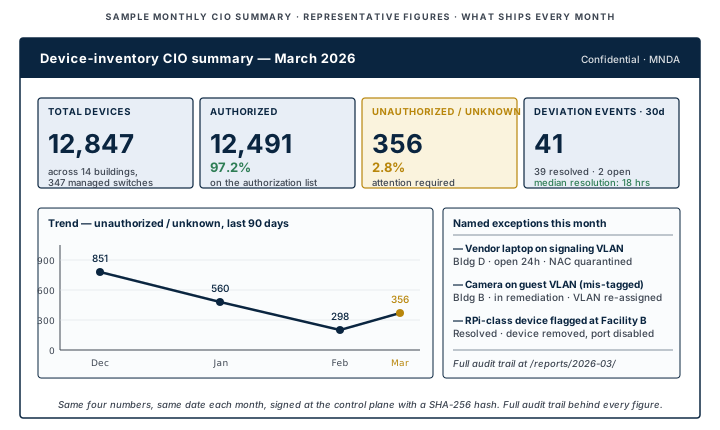
CybrIQ ships these four numbers in a one-page monthly summary the agency CIO can review in three minutes. The same numbers, with full audit trail, sit behind the summary for anyone who needs to dig.
The Section 889 reporting shape
For agencies carrying Section 889 obligations, the reporting expectation is specific:
- Section 889(a)(1)(A): the use of covered telecommunications equipment or services. The reporting shape is "we have no covered equipment in the agency network as of the assessment date," with evidence.
- Section 889(a)(1)(B): contracting with entities that use covered equipment. The reporting shape covers the agency's supply chain, not the agency's network — out of scope for CybrIQ, but the inventory data feeds the contracting-side conversation.
- 889 representations and certifications: FAR 52.204-24, 52.204-25, and 52.204-26 require the agency to receive vendor representations. CybrIQ output supports the agency-side verification of those representations.
The deliverable for Section 889 reporting is a 5-page evidence pack per assessment cycle: scope statement, inventory matched against the covered-entity reference library, deviation log, remediation status, and the controls map. See the Section 889 page for the detection methodology behind the report.
The IG-defensible audit trail
The shape an IG auditor expects:
- Per-device records. Each device with: hardware identifier, vendor, model class, MAC, switch port, VLAN, first-seen timestamp, last-seen timestamp, identification confidence, and authorization status.
- Per-event records. Each detection event with: device identifier, VLAN, severity, similarity score against reference library, supports-controls mapping, response action taken.
- Signed exports. CSV and JSON exports signed at the control plane with a SHA-256 hash, so the IG can verify the file has not been edited between export and assessment.
- Reproducible queries. The auditor asks "show me the inventory on date X" and the deployment returns the same answer it returned then.
Formats CybrIQ ships directly
- One-page monthly CIO summary. The four numbers, the trend, and the named exceptions. PDF or PowerPoint, agency-templated.
- Quarterly oversight pack. 5-10 page deck covering the quarter's inventory, deviation, and resolution shape, mapped to any active IG or GAO findings the agency is closing.
- Annual FISMA-aligned summary. Structured to populate the asset-management responses in the agency's FISMA submission.
- Audit-trail exports. Signed CSV and JSON, on the agency's selected cadence.
- Section 889 evidence pack. Per-assessment-cycle 5-page pack.
- Custom queries. Where the agency's oversight cycle has a specific finding language, the briefing call covers the report shape that matches it.
What CybrIQ does not produce
The discipline: CybrIQ produces inventory-side evidence. The reports above are about devices on the network. They are not:
- SIEM detection-content reports (the SIEM produces those).
- EDR or threat-hunting reports (out of scope).
- Vulnerability-management or patch-management reports (the vulnerability scanner produces those).
- Identity or privileged-access reports (the IAM and PAM tools produce those).
The reporting shape above is specifically for the device-inventory and Section-889 obligations the agency carries. Everything else stays in the tools designed for it.
Walk this against your reporting cycle
30 minutes: we walk your CIO meeting cadence, your active IG findings, your oversight-committee reporting language, and the format your agency expects. We ship sample one-pagers after the call.
Schedule briefing