
CybrIQ is not a NAC, a SIEM, or an EDR. It's the device-discovery layer those tools depend on.
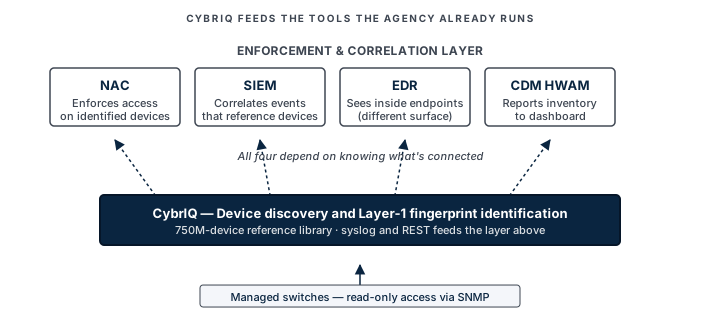
Federal evaluators frequently ask whether CybrIQ replaces an existing tool. The honest answer is: it doesn't. CybrIQ identifies what's connected to the network and feeds that data to the tools the agency already runs. The table below walks the boundary.
CybrIQ vs. NAC (Cisco ISE, Forescout, Aruba ClearPass)
A NAC enforces network-access policy at the switch port. It decides whether a device gets onto the network, onto which VLAN, and with what posture. CybrIQ does not enforce — it identifies. The two work together: CybrIQ's Device DNA identifies the device, the NAC enforces the policy.
| What it does | NAC | CybrIQ |
|---|---|---|
| Identifies connected devices via Layer-1 fingerprint | No (typically MAC OUI + 802.1X identity) | Yes (5-input Device DNA) |
| Recognizes covered telecom hardware (Section 889) | No | Yes |
| Enforces network access policy | Yes | No (CybrIQ feeds the NAC) |
| Quarantines unauthorized devices | Yes | No |
| Requires 802.1X infrastructure | Typically | No |
CybrIQ vs. SIEM (Splunk, Sentinel, QRadar, Elastic)
A SIEM correlates and stores security events. It is not a discovery tool. CybrIQ feeds device-discovery events into the SIEM via syslog (RFC 5424) and REST so the SIEM has the data to correlate against.
| What it does | SIEM | CybrIQ |
|---|---|---|
| Discovers and identifies devices | No | Yes |
| Stores, correlates, and alerts on security events | Yes | No |
| Receives device-inventory feeds for correlation | Yes (consumer) | Yes (producer) |
| Requires storage scaling for long retention | Yes | No (different scale) |
CybrIQ vs. EDR (CrowdStrike, SentinelOne, Defender)
An EDR places an agent on endpoints to monitor behavior and respond to threats. CybrIQ does not place agents on endpoints for device discovery (only the optional USB-protection agent on workstations is an exception). The two see different surfaces — EDR sees inside the endpoint, CybrIQ sees the device on the network.
| What it does | EDR | CybrIQ |
|---|---|---|
| Places agents on managed endpoints | Yes | No (USB protection is opt-in workstation agent) |
| Sees devices that cannot host an agent (OT, lab gear, building systems, cameras) | No | Yes |
| Detects on-host behavior (malware, file changes, lateral movement) | Yes | No |
| Identifies devices via Layer-1 signals | No | Yes |
CybrIQ vs. existing CDM HWAM feed
The CDM HWAM data feed is already running in most federal agencies. CybrIQ does not replace it — it fills the gap. CDM HWAM covers managed IT well; CybrIQ covers the unmanaged half of the network (OT, lab gear, building systems, contractor devices, printers, cameras) and feeds the same dashboard with the same field structure.
| What it does | Existing CDM HWAM | CybrIQ |
|---|---|---|
| Covers managed IT endpoints (laptops, workstations, servers) | Yes | Yes |
| Covers OT, lab equipment, building systems, cameras, printers | No (data sources don't reach) | Yes |
| Identifies covered telecom hardware (Section 889) | No | Yes |
| Feeds the CDM dashboard via syslog / REST | — | Yes |
See how CybrIQ slots in with your existing stack
A 30-minute briefing: we walk integration with the NAC, SIEM, EDR, and CDM tooling you already run. Pull data flow, not procurement-displacement.
Request briefing