
The attack rides a switch port that already has a legitimate workstation on it. The switch-side view cannot see it.
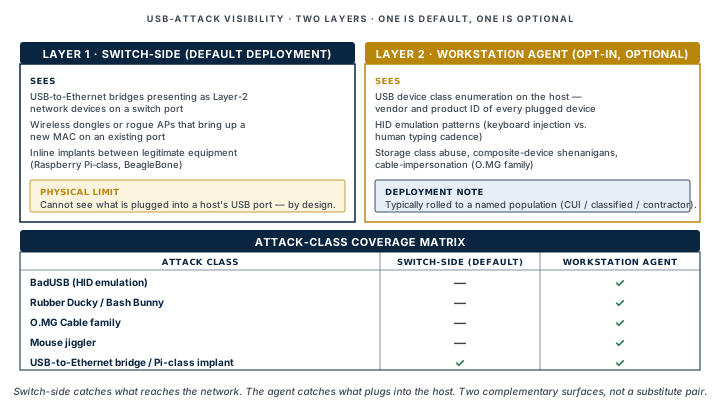
USB-borne attacks — Rubber Ducky, O.MG cable, Flipper Zero, BadUSB-class HID-spoofers, malicious mass storage — present to the switch as the host workstation, not as a new device. CybrIQ's primary deployment (switch-side, agentless) does not see this class on its own. The optional endpoint agent, available on Windows and Linux workstations, fills that gap.
Why USB attacks need a different sensor
A USB device plugged into a workstation does not appear on the network the way a new networked device does. The workstation's MAC, IP, and switch-port identity stay the same; the USB device manifests as a peripheral inside the workstation's operating system. Switch-side detection cannot see what's plugged into the USB port of a host; that's not a limitation of CybrIQ specifically — it's a limitation of any switch-side approach.
The classes of USB attack federal and defense environments care about are well documented. HID-spoofing devices present as a keyboard and type at machine speed (Rubber Ducky, Flipper Zero in BadUSB mode). Cable-form-factor implants like the O.MG cable look identical to a normal USB cable and host a wireless command-and-control surface. Rogue mass storage writes documents off the workstation or carries malicious binaries onto it. Each of these has been documented in federal red-team reports and IG findings over the past five years.
What the endpoint agent does
CybrIQ ships an optional small agent for Windows and Linux workstations. The agent watches USB-device insertion events at the OS level and fires an event when:
- A device is plugged in that does not match the workstation's allow-list of approved peripherals.
- A device claims to be a keyboard but its USB descriptor matches known HID-spoofing implants (Rubber Ducky, Flipper Zero in BadUSB mode, OMG cable family).
- A device's vendor / product ID matches a curated catalog of red-team and offensive-security hardware.
- A device presents as multiple classes (e.g., a "cable" that is also a keyboard and a mass-storage device).
The events feed the same main instance and the same SIEM/NAC integrations as the switch-side device discovery. Detection is on-insertion — the event fires within the operating system's USB event loop, surfaced to the agency's SOC in near-real-time.
Controls CybrIQ supports compliance with
- NIST SP 800-53 Rev. 5 — MP-7 (Media Use), AC-19 (Access Control for Mobile Devices), AC-20 (Use of External Systems), SI-3 (Malicious Code Protection).
- NIST SP 800-171 Rev. 2 — 3.8.7, 3.8.8 (Media Use restrictions).
- CMMC L2 — MP.L2-3.8.7, MP.L2-3.8.8.
- NIST CSF 2.0 — PR.DS (Data Security) and DE.CM (Security Continuous Monitoring) functions.
- HSPD-12 / FIPS 201 — Identification of unauthorized peripheral devices in PIV-card-controlled environments.
Why this is a separate feature, not the default
The endpoint agent is opt-in by environment. The switch-side device discovery (the rest of the CybrIQ deployment) requires no software on the agency's managed assets, by design. The USB-protection feature is the one place CybrIQ ships an agent — and only on environments where the agency decides the trade-off is worth it. Federal evaluators sometimes need that posture as a starting point for the agent-aversion conversation.
Schedule a USB-protection briefing
30 minutes: we walk the threat model, the endpoint-agent posture, and the integration with your existing SOC tooling.
Request briefing