
Transit & surface transportation
Signaling networks, fare collection, station BAS, and the connected-bus telemetry gateway — the visibility TSA Security Directives now expect.
Since the 2021 ransomware incidents in surface transportation, TSA has issued Security Directives covering passenger rail, freight rail, and rail-related transit. APTA's cybersecurity guidance has hardened in parallel. The recurring expectation: a current inventory of critical cyber systems and a documented assessment of what's connected to them. CybrIQ produces that inventory across signaling systems, fare-collection terminals, station building automation, vehicle telemetry gateways, and the IT side that intersects with all of them.
What's regulated and who's asking
- TSA Security Directive 1580/82-2022-01 (Higher-Risk Freight Railroads). Critical cyber system inventory, cybersecurity coordinator, reporting cybersecurity incidents to CISA.
- TSA SD 1580-21-01A and 1582-21-01A (Surface Transportation). Cybersecurity vulnerability assessment, cybersecurity incident response plan.
- TSA SD Pipeline-2021-02D (and related pipeline SDs). Where transit agencies interconnect with pipeline operators, the inventory expectation crosses boundaries.
- APTA Cybersecurity Considerations for Public Transit. Identify-Protect-Detect-Respond-Recover framing, modeled on NIST CSF.
- FTA cybersecurity programs. Federal Transit Administration grant programs increasingly require cyber posture evidence.
- State DOT cybersecurity policies. Many state DOTs have cyber requirements that flow down to transit authorities, port authorities, and toll authorities.
- ITS / V2X / connected-vehicle infrastructure. Roadside units (RSUs), DSRC/C-V2X equipment, traffic-signal controllers, and signal-cabinet PLCs all carry asset-inventory expectations under USDOT and state DOT programs.
Why the device-inventory question is hard for a transit agency
- Signaling networks are operational and brittle. Block signaling, train-control systems (CBTC, PTC), and interlocking PLCs cannot accept active scanning or agent installation.
- Fare-collection terminals span jurisdictions. A regional transit system may operate gates and fareboxes across dozens of stations operated by different agencies. The inventory of what's on each segment is rarely consolidated.
- Station infrastructure is messy. HVAC, lighting controls, public-address systems, dynamic-information displays, CCTV — most of it on flat or lightly-segmented networks.
- Vehicle telemetry gateways are exposed. Buses, light-rail vehicles, and rail consists carry cellular gateways for telemetry, schedule update, and passenger Wi-Fi. The inventory of which gateways are on which network is often vendor-supplied and out of date.
- Vendor and contractor presence. Signal-system vendors, fare-system integrators, station-finish contractors — all plug equipment in routinely.
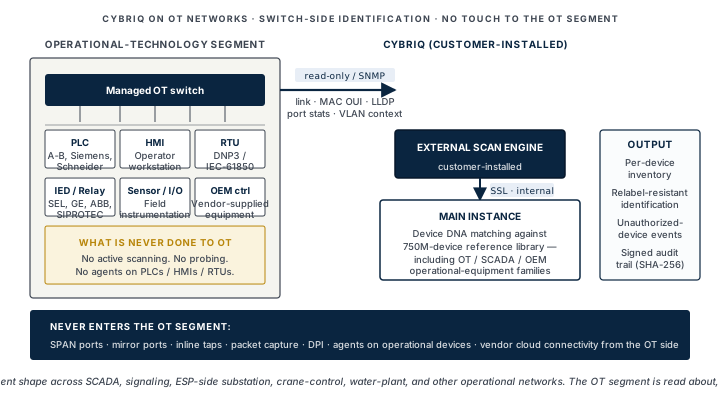
How CybrIQ identifies devices on a transit network
- Switch-side, read-only signals. Identification from managed switches via SNMP with read-only credentials. No active scanning of OT segments. No agents on PLCs, RTUs, vehicle-telemetry gateways, or fare terminals.
- Transportation-OT reference library. The Device DNA library identifies signaling and traffic-control PLC families, fare-system vendor hardware classes, vehicle telemetry gateway classes, RSU / DSRC / C-V2X equipment, and station BAS controllers.
- Cross-segment visibility. One deployment covers signaling, fare, station, IT, and ITS roadside-unit segments — provided the segments share managed-switch infrastructure CybrIQ can read against.
- Unauthorized-device detection. Vendor laptop on a signaling-vendor maintenance VLAN that should have been disconnected. A wireless bridge installed during a station-finish project. A USB-to-Ethernet adapter on a fare terminal.
Reporting alignment
- TSA SD critical cyber system inventory. Per-segment device inventory with class, vendor, model. Updated as systems change.
- TSA cybersecurity vulnerability assessment. The inventory is the input layer; the assessment is conducted against it.
- TSA cybersecurity incident reporting. Device-level audit trail for the reportable-incident timeline.
- APTA framing for board / oversight reporting. The Identify function output, in language the agency's board reads.
- FTA grant-reporting alignment. Pre- and post-investment device-visibility numbers for grant-period evaluation.
Recent incident context
- NY MTA (Apr 2021). APT exploitation in agency systems disclosed publicly. Triggered hardening across major US transit agencies.
- SF Bay Area transit, Denver RTD, other US agencies (2022-2024). Ransomware and unauthorized-access incidents at fare and operations systems. Each raised the floor of carrier and oversight expectation.
- Volt Typhoon advisories (CISA AA24-038A and related). Specifically named US transportation infrastructure as targeted for pre-positioning on edge devices. The relevance for transit IT: every connected edge device is now an inventory question.
Schedule a transit briefing
30 minutes. We walk CybrIQ against your specific signaling, fare, station, and vehicle-telemetry topology, your active TSA SD obligations, and your APTA-aligned reporting cycle.
Request briefing