
Six frameworks, one question. They all want to know what's on your network and whether you noticed when it changed. CybrIQ produces the answer continuously, so audit prep stops being a project.
PCI 4.0 came into force March 2025. SOC 2 Type II expects a 12-month evidence trail, not a point-in-time snapshot. HIPAA's 2025 Security Rule update tightened inventory and risk-analysis expectations. NIST CSF 2.0 added a Govern function that puts the inventory question on the board's plate. CMMC Level 2 made third-party assessment mandatory for the DIB. NDAA Section 889 banned-vendor screening crept from federal contractors into commercial questionnaires. The control questions on every one of these converge on the same artifact, and most SMB security teams produce it the same way: a six-week scramble starting four weeks before the auditor walks in.
The control questions the inventory artifact answers.
Each framework phrases it differently. The artifact you produce is the same. Below are the actual control IDs your auditor will be asking about, and what CybrIQ's evidence pack maps to.
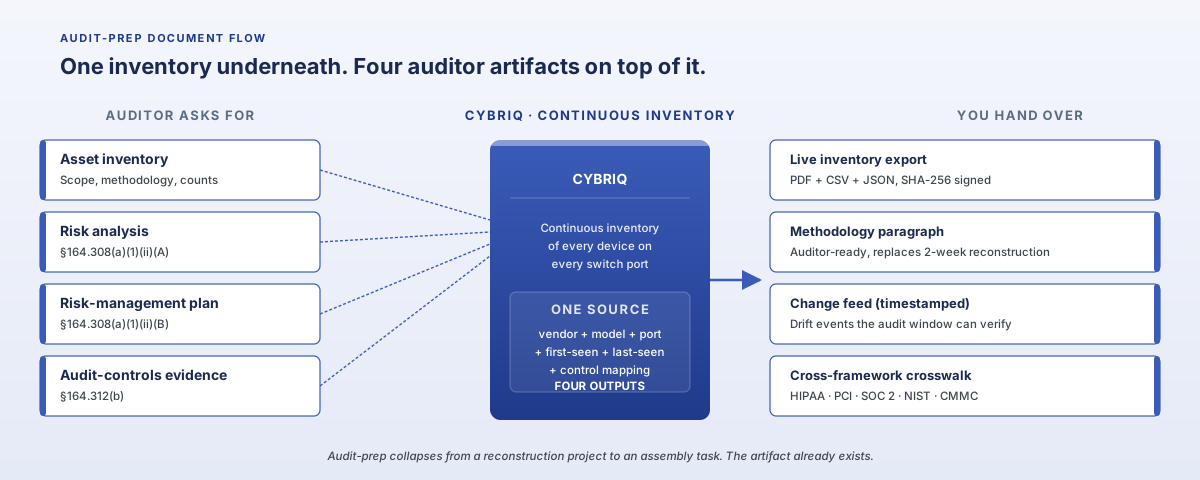
One artifact. Six framework-specific cover sheets. The control mapping is configuration, not workflow.
PCI DSS 4.0
Requirement 12.5.1: Maintain an inventory of system components in scope for PCI DSS. Requirement 11.5.1: Deploy change-detection mechanisms on critical files and configurations.
CybrIQ closes 12.5.1: continuous CDE-device inventory with vendor, model, first-seen, last-seen, and identity verification (the device is what it claims to be). 11.5.1 (file and configuration change-detection inside the device) is outside our scope; it requires a complementary file-integrity-monitoring tool, which we integrate alongside without overlap.
SOC 2 Type II (CC and PI series)
CC6.1: Logical and physical access controls. CC6.6: Logical access security measures for systems. CC7.1: Detection of system components added or removed. CC7.2: Monitoring system components for malicious activity.
CybrIQ ships: the 12-month trail of every device add, remove, and change, mapped to the change-management ticket where one exists. The trail is the trust-services-criteria evidence; the gaps in the trail are the exceptions you discuss with the auditor.
HIPAA Security Rule (2025 update)
§164.308(a)(1)(ii)(A): Risk analysis must include all electronic protected health information assets. §164.308(a)(7)(ii)(E): Application and data criticality analysis. §164.312(b): Audit controls covering activity on ePHI systems.
CybrIQ ships: the asset inventory the risk analysis depends on, with criticality scoring drawn from network position and the framework controls each device satisfies. Auditors flag risk-analyses based on outdated inventories more often than any other ePHI-environment finding.
NIST CSF 2.0
ID.AM-01: Inventories of hardware managed by the organization. ID.AM-02: Software, services, and systems inventoried. GV.SC-02: Cybersecurity supply-chain risk management roles and responsibilities. DE.CM-01: Networks and network services monitored for adverse events.
CybrIQ ships: the ID.AM-01 and DE.CM-01 evidence in one artifact, plus the supply-chain (GV.SC-02) screening data. The 2.0 Govern function pushed the inventory question onto the board's plate; the same export answers both audiences.
CMMC Level 2 (DIB contractors)
CM.L2-3.4.1: Establish and maintain baseline configurations and inventories. SI.L2-3.14.6: Monitor system communications and use to detect attacks.
CybrIQ closes the inventories half of CM.L2-3.4.1: continuous identity-verified device inventory at the CUI-handling segments. The baseline-configurations half of 3.4.1 (and CM.L2-3.4.2, configuration-settings enforcement) is outside our scope and requires a complementary configuration-management tool. We close SI.L2-3.14.6 at the device-identity layer: continuous device-level change-monitoring trail that the C3PAO will request during the assessment.
NDAA Section 889 / FAR 52.204-25
Federal contractors are prohibited from using covered telecommunications equipment from a defined list of foreign vendors. The prohibition extends to indirect use: equipment installed by suppliers, equipment purchased through resellers, equipment present anywhere on networks that touch federal information.
CybrIQ ships: continuous Layer 1 fingerprint screening against the federal banned-vendor list, with confidence scoring. Empty is the answer the contracting officer wants; the screening report is the evidence that you're actively checking, not relying on procurement records that don't capture relabeled hardware.
What collapses in the timeline.
A typical six-week scramble breaks down like this. Week one: pull the asset register from the CMDB and the network inventory from whatever tool last touched it. Week two: reconcile them, because they disagree by ten to thirty percent. Week three: chase down ownership for the orphan assets nobody claims. Week four: build the framework-control mapping spreadsheet from scratch. Week five: assemble the evidence packet, hand it to QA, fix the gaps QA finds. Week six: the auditor walks in, asks for one artifact you didn't anticipate, and you spend three days producing it.
With continuous inventory the timeline collapses because the reconciliation, the framework mapping, and the change history are already there. You're not building the evidence packet; you're filtering it for the framework the auditor showed up to assess against. Day one is the framework selection. Day two is the cover-letter and engagement-package assembly. Day three is the dry-run with the engagement lead. Day four is the package handoff. The four-day claim is the median pilot result; your mileage will vary with the depth of the audit and the maturity of your change-management process. But the order-of-magnitude shift is real and replicable.
Audit-prep labor is the line item nobody captures cleanly because it pulls from too many cost centers: security, ops, IT, compliance, and frequently outside consultants when the inventory reconciliation runs over. The four-day collapse shows up in three places: internal labor (two FTEs reclaim three to five weeks of capacity each), consultant spend (most pilots eliminate the inventory-reconciliation engagement entirely), and audit fees (auditors charge for the back-and-forth; fewer exchanges, lower invoice).
What the auditor takes away.
Three artifacts. Forwardable, signed, and structured the way the assessor's working paper expects.
1. The framework-mapped inventory export
The complete device list, with framework controls each device satisfies, criticality tier, and last-seen timestamp. PDF for the audit binder, JSON for the auditor's tooling. Signed at the control plane; the signature is the integrity evidence.
2. The change-trail export
Every device add, change, and remove over the reporting window, cross-referenced against your change-management system. The cross-reference is the evidence that approved changes flow correctly; the unreferenced events are the exceptions the auditor will discuss with you. Discussing exceptions is normal; the auditor's report is about how you discussed them.
3. The supply-chain screening report
Layer 1 fingerprint matches against the NDAA 889 list, the federal-prohibited list, and any additional supply-chain risk lists you maintain. CMMC and federal-contractor environments need this; commercial environments increasingly include it in the SOC 2 supplementary evidence.
Next audit on the calendar in the next two quarters?
A live demo of the platform and a conversation about whether CybrIQ fits your environment. The framework-mapped artifacts are designed to slot into the assessment process your auditor already runs.
Book a demo