Your carrier stopped accepting attestation. They want evidence. CybrIQ produces it on the schedule the underwriter actually wants.
Renewal questionnaires in 2026 are not what they were three years ago. Risk-based underwriting replaced flat-rate pricing. Your premium is now a function of the security maturity you can prove with artifacts, not attest to with a checkbox. This page is about what's actually on the questionnaire, what CybrIQ produces for each line item, and how the conversation with your broker changes when you have continuous evidence instead of a renewal-week scramble.
What the renewal questionnaire actually asks for.
Eight questions show up on most 2026 questionnaires. Five of them depend on knowing what's on your network. Those five are the ones CybrIQ closes; the other three are not in our scope, and we'll tell you which ones.
The 2026 carrier questionnaire shape. Five of eight items map to continuous device evidence.
1. "Do you have a complete inventory of all network-connected devices, with quarterly review?"
The question every carrier opens with. Most SMBs answer "yes" because the CMDB exists, and most SMBs are quietly wrong by 10 to 28 percent. The carrier accepts the "yes" today, but the policy language is shifting: misrepresentation in the application is now a coverage exclusion in several mid-market carriers' standard wording. The right answer is "yes, continuously, here's the export." CybrIQ produces that export.
2. "Do you have evidence of unauthorized device detection on your network?"
New on most 2026 questionnaires. Carriers want to see drift detection: when something appears, when something changes, when something doesn't match the register. The CybrIQ drift report is the artifact that answers this question. Each event timestamped, framework-mapped, signed at the control plane.
3. "Do you screen for prohibited or sanctioned-vendor hardware on your network?"
The NDAA Section 889 question, increasingly common outside federal-contractor scope as carriers underwrite cross-border supply-chain risk. CybrIQ flags banned-vendor matches against the federal list automatically, with confidence scoring. Most pilots find at least one. Federal-contractor environments find more.
4. "Do you have continuous evidence of change oversight at the device-identity layer?"
The narrower version of the carrier's change-management question, scoped to what CybrIQ produces. Each device-level drift event (additions, removals, identity changes) is cross-referenced against your change-management system; the auto-suppression record is your evidence that approved device changes flow through correctly. Broader software, file, and configuration change-management is outside our scope and lives in your other tooling.
5. "Do you have documented incident-response procedures for hardware-tampering events?"
A documented on-call playbook ships with the deployment, covering the per-event response. Forwardable to your underwriter. The playbook covers swap detection, NDAA-prohibited detection, topology change, and USB-attack detection, each with the 90-second decision tree your SOC analyst uses.
What changes in the broker conversation.
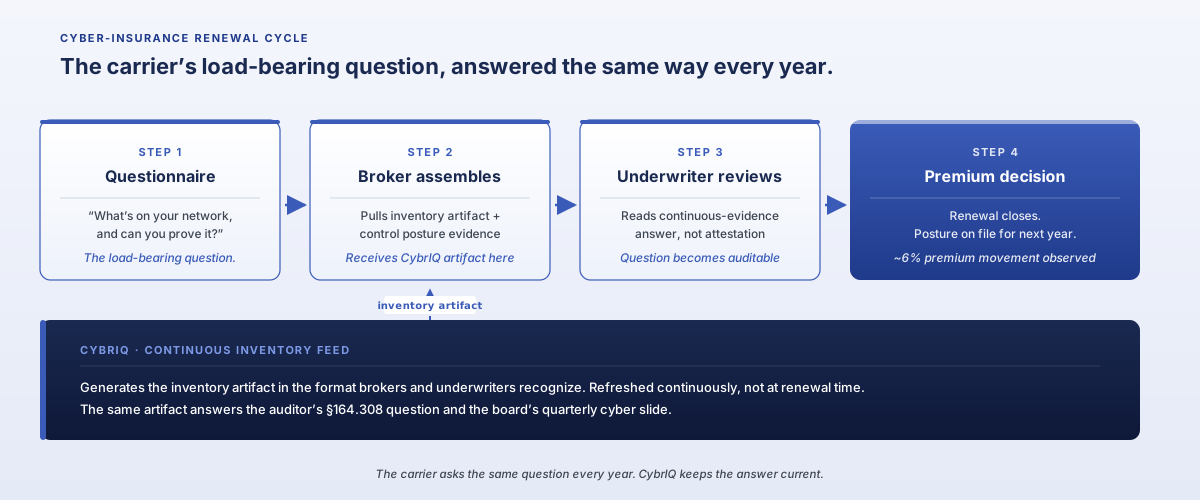
Brokers I've worked with describe the renewal conversation in two modes. Mode one: the broker hands you the questionnaire and you and your team spend two weeks reconstructing answers, mostly from memory and partial documentation. The broker submits whatever you produce, the carrier asks follow-ups, you produce more, the renewal goes through at a premium they offered before you even started. Mode two: you and the broker open the conversation by showing the carrier your continuous evidence. The questionnaire becomes a checkbox exercise. The carrier asks fewer follow-ups. The premium conversation moves from "here's what we're offering" to "what do you need to see for the discount."
Mode two is the one continuous-evidence tools enable. Continuous evidence doesn't guarantee a lower premium; carriers reserve that decision. The guarantee is structural: you're answering questions from artifacts instead of reconstructing them, and that changes how the broker positions you with the underwriter. The Directors who've made that shift describe it the same way: "renewal week stopped being a project."
Bring up CybrIQ before the questionnaire goes out. Brokers who've worked with us know the artifact shapes; they can pre-position the evidence with the carrier. The artifact-first conversation saves the broker as much time as it saves you.
What CybrIQ ships for the carrier specifically.
All three deliverables are signed at the control plane and exportable on demand. Your broker passes them through to the underwriter unmodified.
1. The continuous inventory export
Every device on the network, with vendor, model, first-seen, last-seen, similarity score against the baseline, and the framework controls each device satisfies. Signed PDF + signed JSON. Same artifact the auditor wants, formatted for the underwriter.
2. The 30-day drift report
Every change to the inventory over the reporting window. Each drift event timestamped, attributed (where attribution is possible), and cross-referenced against the change-management ticket that should have authorized it. The carrier sees you have eyes on change-management, not just inventory.
3. The NDAA / sanctioned-vendor screening report
The list of devices on your network whose Layer 1 fingerprint matches a banned-vendor entry in the federal lists. Empty is the answer carriers want; "empty after we removed these three cameras last month" is also a fine answer. The report is generated automatically; it doesn't require a quarterly procurement audit to produce.
Renewal in the next 90 days? Let's pre-position the evidence.
A live demo of the platform and a conversation about whether CybrIQ fits your environment. The renewal-facing artifacts are designed to slot into the conversation your broker already runs with carriers.
Book a demo