CybrIQ × Utelogy · sum greater than parts
CybrIQ × Utelogy/Sum greater than parts
Why buy CybrIQ through Utelogy

Adding a security tool takes a procurement quarter. A line-item amendment to your Utelogy contract takes a week.

The customer with 400 AV-enabled rooms doesn’t need another vendor onboarding. They need the CISO’s hardware-inventory question answered before the renewal underwriter asks it again. Utelogy reselling CybrIQ collapses that conversation from a procurement cycle to a contract amendment.

The audit question that doesn’t belong to the AV team

Walk into any enterprise IT shop running 200 or more AV-enabled rooms and the security team is chasing the same evidence:

  • SOC 2 / ISO 27001 / NIST 800-171 / CMMC L2. Continuous, dated hardware inventory of what is actually plugged into the network, not what the asset register says.
  • NDAA Section 889. A current scan that catches covered hardware (Huawei, ZTE, Hytera, Hikvision, Dahua) even when shipped under a different label.
  • 2026 cyber-insurance renewal. A signed export the underwriter accepts as evidence, with a current date, not a policy attestation.

None of those land on the AV team to operate. They land on the security team to evidence. The customer’s pain isn’t “we don’t have a tool.” The customer’s pain is “adding another vendor, another contract, another security review takes a quarter we don’t have.” Utelogy reselling CybrIQ removes the procurement-cycle delay.

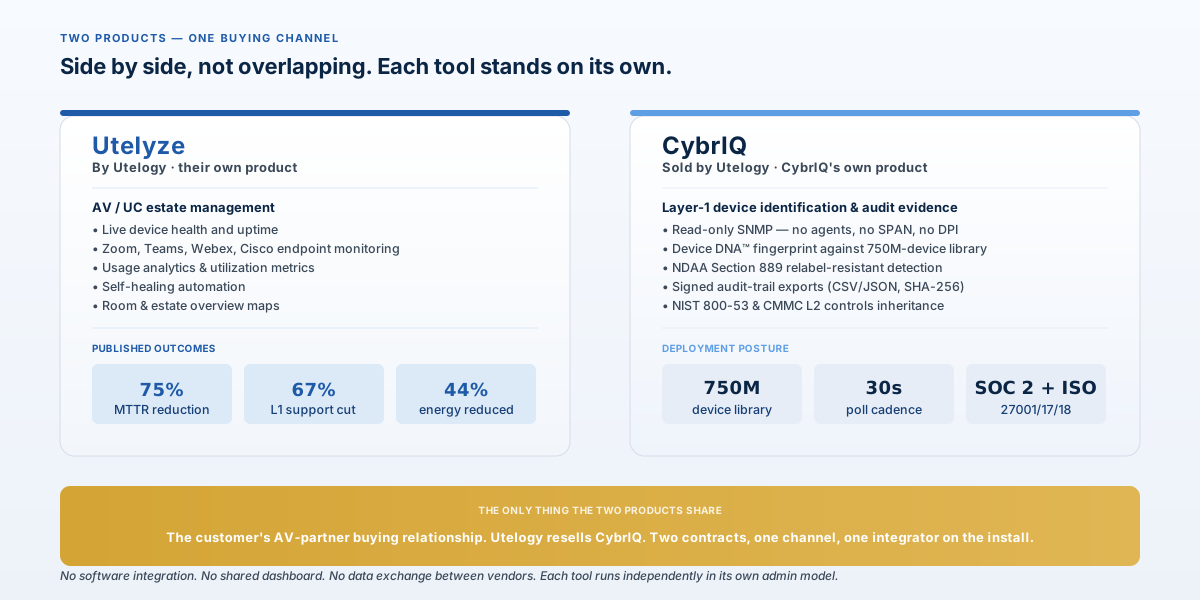
A side-by-side comparison of the two distinct products that Utelogy resells to customers. The left card describes Utelyze (Utelogy's own product, the AV / UC estate management platform): live device health and uptime, Zoom / Teams / Webex / Cisco endpoint monitoring, usage analytics, self-healing automation, and the published outcomes of 75 percent MTTR reduction, 67 percent L1 support-call reduction, and 44 percent energy reduction. The right card describes CybrIQ (the security and audit product Utelogy resells): Layer-1 device identification via SNMP with read-only credentials, Device DNA fingerprinting against a 750-million-device reference library, NDAA Section 889 relabel-resistant detection, signed audit-trail exports, and SOC 2 plus ISO 27001 / 27017 / 27018 certifications. A gold bar at the bottom names the only thing the two products share: the customer's AV-partner buying relationship through Utelogy. Two contracts, one channel, one integrator on the install. No software integration between the vendors.

The managed-service path: the integrator runs CybrIQ for you

The customer with 400 rooms in scope usually does not want to add a security tool their AV team has to operate. The path that works: the integrator who runs the Utelogy deployment also runs CybrIQ as a managed service on the same switch fabric. They handle the SNMP credential handoff with the customer’s network team, they own the alert-review cadence, and they deliver a monthly signed inventory PDF to the customer’s CISO mailbox. The AV team never touches it. The CISO never has to learn a new console. The integrator gets a new recurring SKU on every Utelogy account.

Three audiences, one channel

The reason the pairing works isn’t that one team uses both tools. It’s that three different audiences inside the customer org each get something they were already asking for, delivered through the AV channel they already trust.

AV ops

The AV / IT operations team

Stays in Utelyze. Workflow does not change. Tickets, MTTR, self-healing automation, room health continues exactly as it does today. CybrIQ never touches their day.
CISO

The CISO or compliance lead

Receives a monthly signed CybrIQ inventory PDF. Forwards to audit, to the carrier on renewal, to the IG on Section 889 requests. They consume the artifact. They don’t operate the tool.

Integrator

The integrator

Runs the install on the existing switch fabric (same trip, same change window). Optionally operates CybrIQ as a managed-service line item. Adds a recurring SKU on every Utelogy account.

The compliance side: which artifact answers which question

The audit and underwriting teams already know the framework mapping. The signed CybrIQ inventory artifact is the document they need. Utelogy’s operational-monitoring evidence answers a separate set of questions. Below is the mapping, plainly.
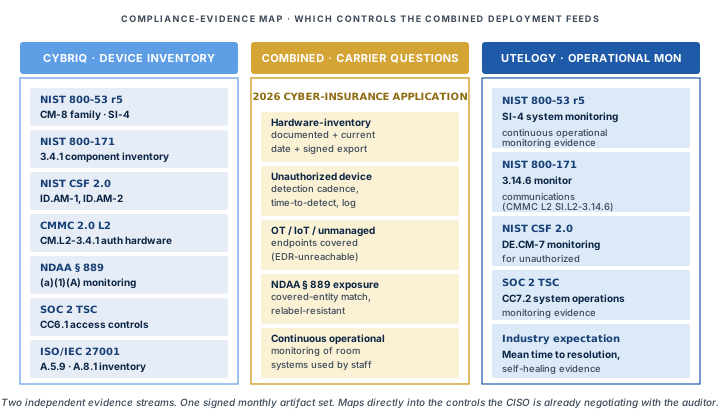
A compliance-evidence mapping diagram showing which product's evidence stream answers which framework control. CybrIQ's signed device-inventory artifact maps to NIST SP 800-53 Rev 5 CM-8 family and SI-4, NIST SP 800-171 control 3.4.1 System Component Inventory, NIST CSF 2.0 ID.AM-1 and ID.AM-2 Asset Management, CMMC 2.0 Level 2 CM.L2-3.4.1 Authorized Hardware, NDAA Section 889(a)(1)(A) monitoring, SOC 2 Trust Services Criteria CC6.1, and ISO/IEC 27001 A.5.9 and A.8.1 inventory. Utelogy's operational-monitoring evidence maps to NIST 800-53 SI-4 System Monitoring, NIST 800-171 3.14.6, CMMC L2 SI.L2-3.14.6, NIST CSF 2.0 DE.CM-7, SOC 2 CC7.2 System Operations, and industry MTTR / self-healing expectations. A middle column shows the 2026 cyber-insurance application questions each product separately feeds answers into: documented hardware inventory (CybrIQ artifact), unauthorized-device detection cadence (CybrIQ artifact), OT / IoT / unmanaged endpoints covered (CybrIQ artifact), NDAA Section 889 exposure (CybrIQ artifact), and continuous operational monitoring of the room systems staff use (Utelogy artifact).

Five places this channel arrangement saves time

  1. Procurement cycle. CybrIQ is sold through your existing Utelogy contract. No new vendor onboarding, no new security review, no new MSA. The procurement quarter you usually lose adding a security tool collapses to a line-item amendment.
  2. The CISO mailbox. A monthly signed inventory PDF arrives in the CISO’s inbox without anyone on the security team having to learn a new console. The artifact is what the audit and the carrier want; the operator role lives with the integrator.
  3. The audit submission. The CISO ships the CybrIQ signed export alongside Utelogy’s operational-monitoring evidence. Two artifacts, one submission, mapped to CM-8 / ID.AM-1 and SI-4 / DE.CM-7 respectively.
  4. The cyber-insurance renewal. The hardware-inventory question on the application gets a signed export from CybrIQ. The unauthorized-device-detection question gets CybrIQ’s deviation log. The continuous-monitoring question gets Utelogy’s MTTR / self-healing evidence. Each carrier (Travelers, AIG, Beazley, Chubb, Coalition, Hartford) gets the artifact set the underwriter actually asked for.
  5. The integrator visit. The integrator who runs your Utelogy deployment also installs CybrIQ on the same switch fabric. One trip, one change-management window, one SNMP-credential handoff with your network team. Optionally the same integrator operates CybrIQ as a managed service after install, so no one on your team has to.
What this is, plainly

Utelogy resells CybrIQ. The integrator operates it. You consume the artifact.

The two products are separate. Utelogy’s software does what it has always done. CybrIQ’s software does what it has always done. The pairing isn’t a software merge; it’s a channel arrangement plus an optional managed-service tier. You are buying the gap-closure, not a new console to staff.

What this is not

Naming the limits is part of the honest pitch:

  • It is not a software integration. The two products do not share a dashboard, share credentials, or exchange data between vendors.
  • It is not a replacement for the customer’s NAC. CybrIQ feeds the NAC; the NAC enforces.
  • It is not a SIEM. CybrIQ feeds the SIEM via syslog (RFC 5424) and REST; the SIEM correlates and stores.
  • It is not an EDR. CybrIQ does not place agents on endpoints for the primary feature. The optional CybrIQ USB-protection workstation agent is separate and opt-in.
  • It is not a packet-capture or DPI tool. Identification is from switch-side signals only, via SNMP with read-only credentials.

See it against your environment.

30-minute working session. Your room count, your audit cadence, your insurance renewal cycle. One concrete next step at the end of the call.

Schedule a working session