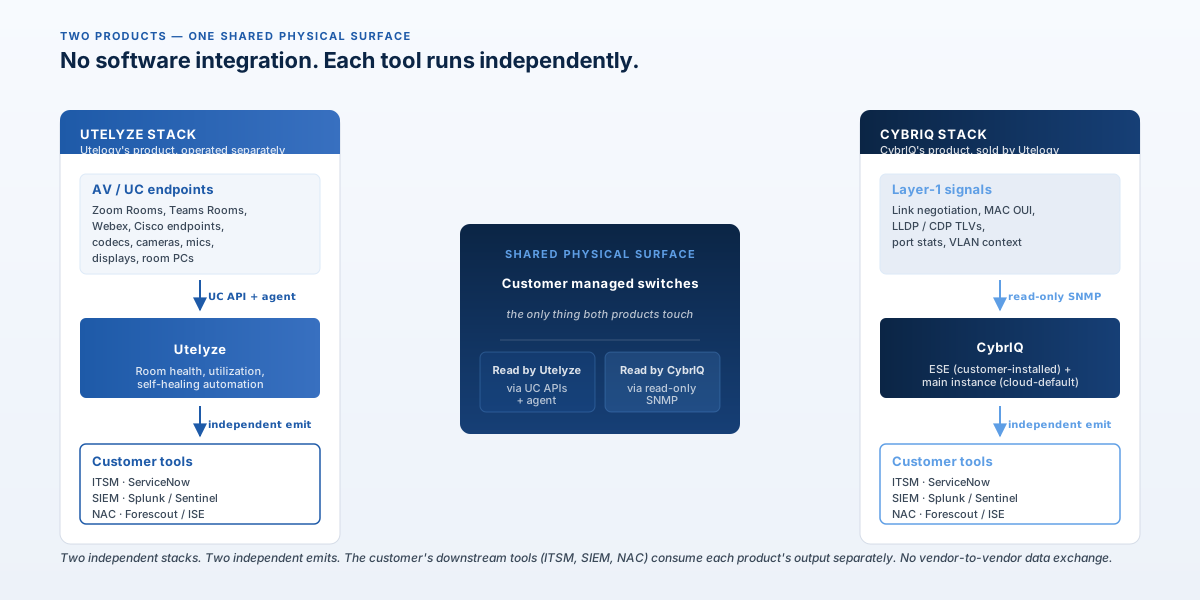
Two independent stacks. One shared physical surface.
Utelyze reads AV and UC endpoints through manufacturer APIs and its own agent. CybrIQ reads the managed switches those endpoints attach to, via SNMP with read-only credentials. The two products do not exchange data with each other and do not share a dashboard. Each emits independently to the customer's existing ITSM, SIEM, and NAC. The only thing they share is the customer's managed switch fabric.
What each side reads
Utelogy side
Utelogy reads from the AV and UC endpoints in each room through manufacturer APIs, REST integrations, and its own monitoring agent where the endpoint supports one. The data set includes:
- Live device health and uptime per endpoint.
- Video conferencing platform status (Teams, Zoom, Webex, and the wider list).
- Firmware versions and configuration mismatches.
- Usage data and performance metrics per room.
- Room and estate overview maps.
- Self-healing automation events (the room remediated itself; we still want to know).
CybrIQ side
CybrIQ reads from the managed switches the AV and UC endpoints attach to. The data set includes:
- Link negotiation pattern per port.
- MAC OUI of every device.
- LLDP / CDP TLV ordering and vendor-specific advertisements.
- Port statistics, error rates, and link history.
- VLAN context and topology.
- Layer-1 fingerprint (Device DNA™) matched against the 750-million-device reference library.
What the two products do not share
Naming the limits matters. The two products run independently:
- No data exchange between vendors. CybrIQ does not push device identity into Utelyze, and Utelyze does not push room context into CybrIQ. Each tool operates in its own data plane.
- No shared dashboard. Utelyze runs at
utelyze.utelogy.com(or the customer's on-prem Utelyze install). CybrIQ runs atapp.cybriq.io(or the customer's on-prem CybrIQ install). Two URLs, two authentication realms, two operator teams. - No shared credentials. Each product is administered by its own credentials and its own RBAC.
The customer typically routes both products' outputs into the same downstream tools (ITSM, SIEM, NAC), and the customer's operations team correlates there. That correlation happens in the customer's stack, not in either vendor's product.
What the customer installs
- Utelyze. Utelogy-hosted cloud by default, or customer-installed (Utelogy offers both shapes).
- CybrIQ External Scan Engine (ESE). Customer-installed on customer hardware. One ESE handles up to 500 switches.
- CybrIQ main instance. CybrIQ-hosted in the cloud by default, with an on-premise option for regulated environments. SSL between ESE and main, inside the customer network.
What the customer does not need
- No SPAN port, mirror port, or inline tap (CybrIQ side).
- No agents on AV endpoints, room PCs, or peripherals (CybrIQ side; Utelogy uses its own monitoring agent where the endpoint supports one).
- Vendor-cloud-dependency is optional: both Utelogy and CybrIQ default to cloud-hosted main components, and both support fully customer-installed on-premise shapes for regulated environments.
- No new firewall openings to third-party clouds.
- No new credentials beyond what Utelogy and CybrIQ each already require.
What the first 90 days look like
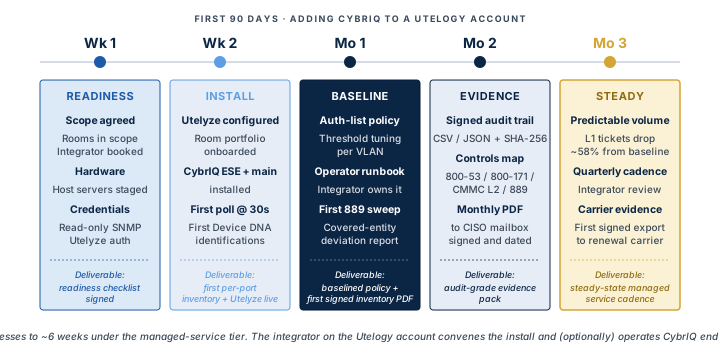
The deployment timeline is owned by the integrator on the Utelogy account. The diagram below is the standard 90-day shape; under the managed-service tier where the integrator runs the operator role end to end, the same shape compresses to roughly six weeks.
Downstream destinations
Both tools feed the same existing customer infrastructure. Identity events (CybrIQ) and operational events (Utelogy) emit on RFC 5424 syslog and REST, with structured-data fields that the customer's SIEM, NAC, ITSM, and compliance platforms can route on.
- ITSM. ServiceNow (and others). Tickets auto-tagged with room context and device identity.
- SIEM. Splunk, Splunk Cloud for Government, Microsoft Sentinel, IBM QRadar, Elastic.
- NAC. Cisco ISE (pxGrid), Forescout, Aruba ClearPass. Identity events feed NAC's policy decision; Utelogy events feed NAC's room-context awareness.
- Compliance & GRC. eMASS (federal), Vanta, Drata, Archer, ServiceNow GRC. Signed CSV / JSON exports with SHA-256 hash.
Walk this against your network.
30 minutes with a CybrIQ engineer. We walk the integration shape against your switch fabric, your Utelyze deployment, and your existing ITSM / SIEM / NAC. You leave the call knowing whether the pairing makes sense and what the install week looks like.
Schedule a working session